
Recently, while setting up part of my family archive on WeAre.xyz, I decided to revisit some of the records for my direct ancestors. One particular ancestor quickly caught my attention — Elizabeth SHERWOOD (née SMITH).
What I knew already
At first glance, I realised just how little I actually knew about her life.
What I had documented was fairly straightforward:
- Born circa 1790 in Cambridgeshire, England
- Married William SHERWOOD on 8 June 1807 in Middlesex, England
- Mother of four children born in Fowlmere, Cambridgeshire
- Appeared with her husband in the 1841 UK Census in Fowlmere, Cambridgeshire
- Widowed in 1843 when William died in Fowlmere, Cambridgeshire
- Died 1873 in South Australia.
There was a gap of more than thirty years in her story.
Question to research
The obvious question became: when did Elizabeth migrate to Australia?
To investigate, I turned to the South Australian passenger records available through the State Records of South Australia, specifically the 1845–1886 Official Assisted Passenger Lists (GRG 35/48/1). This collection covered the timeframe I was interested in, so it seemed like the logical place to start.
As I searched the index, something unexpected appeared.
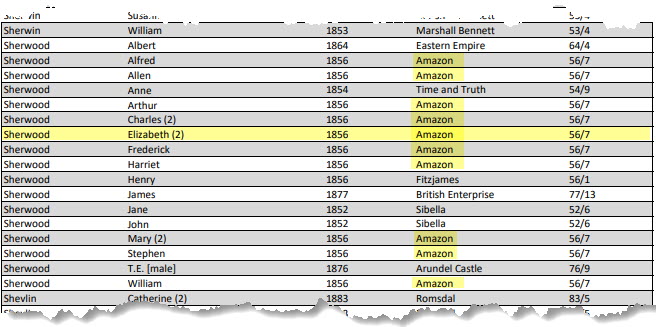
There were two Elizabeth SHERWOODs listed on the same ship.
Even more interestingly, there were a large number of passengers with the surname SHERWOOD aboard the vessel Amazon.
That immediately sounded familiar.
Digging back through my earlier research, I found notes relating to Charles and Mary SHERWOOD and their ten children, who I had recorded as arriving in South Australia aboard the Amazon in 1856. But now I was seeing thirteen people with the surname SHERWOOD on the same voyage.
Something clearly deserved a second look.
Source & Research Quality
When I reviewed the source I had originally used for the family’s migration, I realised it was not a primary source at all. In fact, it was not even a secondary source. It was a tertiary source — a transcript of a newspaper article published in 1856.
And there, buried in plain sight, were the two Elizabeth SHERWOODs.
Forty years ago, when I first completed this research as a beginner genealogist, I had simply assumed the second Elizabeth was either an error or unrelated to my family. I had discounted her without properly investigating further.
It was a classic newbie mistake.
This time, instead of relying on a transcript, I went back to the original passenger lists held by the archive and carefully reviewed every page of the record set.
And there they were.
Two Elizabeth SHERWOODs.
One Elizabeth was aged 10 — clearly the daughter of Charles and Mary SHERWOOD.
The second Elizabeth was aged 65.
That age placed her birth around 1791.
This was my Elizabeth SHERWOOD (née SMITH).
After decades of uncertainty, I finally discovered that Elizabeth had travelled to South Australia alongside her son Charles, his wife Mary, and their ten children aboard the Amazon in 1856.
Mystery solved.
But more importantly, the discovery served as a powerful reminder of some of the most valuable lessons in family history research.
Lessons Learned
- Revisit old research, especially work completed when you were just starting out.
- Whenever possible, work from primary sources rather than transcripts or indexes alone.
- Read the entire record, not just the section that immediately relates to your ancestor. Family, friends, associates, and neighbours often appear together.
- Revisit collateral family lines regularly — they may hold the key to solving gaps in your direct line.
- Return to online databases frequently as new records are added all the time.
- Explore archive catalogues carefully. Even when records are not digitised, the catalogue itself may point you toward valuable material worth accessing in person.
- Stay curious about your ancestors and their lives.
- Remember that genealogical research is never truly finished.